Results at a glance
Industrial – 10,000 m² – pilot started in July 2024
- 170 MWh in total energy savings during the evaluation period.
- 63% lower electricity use for ventilation, approximately 70 MWh.
- 17% savings in the heating circuit, approximately 100 MWh.
Results apply to the defined part of the depot included in the pilot project.
The property and the challenge
Örebro CV is a 10,000-square-metre industrial property owned and managed by Jernhusen. Used as a depot, the building has different indoor climate and air quality requirements from an office or retail property. The working environment is central, and ventilation plays an important role in maintaining safe air quality for people working on site.
Sally R began a proof of concept for a clearly defined part of the depot in July 2024. The project was carried out with Siemens, connecting the property and Sally R’s platform through Siemens Building X.
Integration via Siemens Building X
The project shows how Sally R’s platform can integrate through third-party systems rather than directly with a BMS. Siemens Building X provided the connection to the building’s control system, opening up a broader range of integration options depending on the infrastructure already in place.
Predictive models continuously analysed building data and weather forecasts to calculate optimal setpoints for ventilation and the heating circuit. New settings were sent to the control system every five minutes, autonomously and without manual intervention.
Air quality sensors were also installed, enabling continuous monitoring of VOC levels in the depot. This is particularly relevant in an industrial setting where air quality directly affects the working environment.
The results
During the evaluation period, electricity savings for ventilation reached 63%, equivalent to approximately 70 MWh. The heating circuit achieved savings of 17%, or around 100 MWh. Total energy savings amounted to 170 MWh.
The working environment remained stable and good throughout the evaluation. Indoor conditions stayed within the desired range despite the substantial reduction in energy use, confirming that savings did not come at the expense of comfort or safety.
Air quality sensors also enabled Sally R to identify and manage VOC levels proactively, which had not previously been possible without continuous measurement.
What the Siemens collaboration demonstrates
The Jernhusen project shows that Sally R’s platform is not limited to direct BMS integrations. Through established partners such as Siemens, it can reach properties with infrastructure from leading system suppliers, without requiring the owner to replace or supplement the underlying installation.
This is an important step towards scaling. More integration options allow more properties to benefit from optimisation without being held back by technical compatibility issues.
Measurements and follow-up
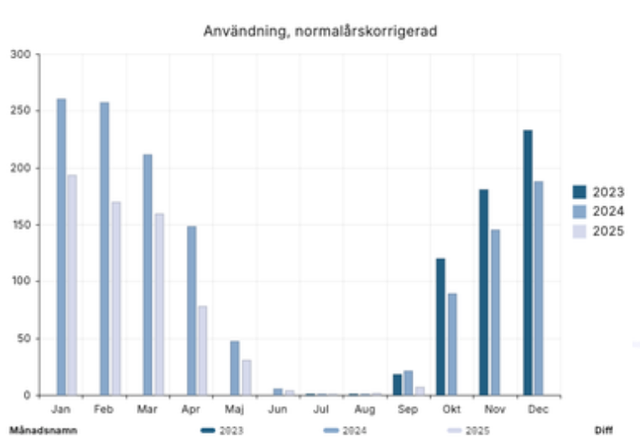
Space-heating energy use at Örebro CV.
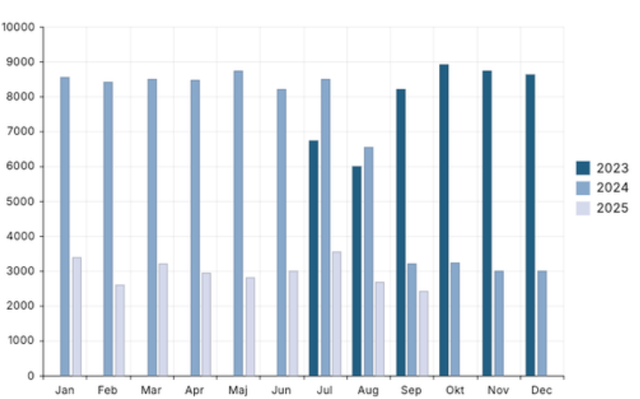
Electricity use for ventilation at Örebro CV.